Boxing Footwork Drills: A Comprehensive Guide
This guide delves into effective boxing footwork drills, detailing benefits and techniques. Numerous Boxing Footwork Drills PDF eBooks are available, dedicated to enhancing skills.
Explore comprehensive resources, including a Boxing Footwork Guide with illustrations, readily downloadable as a PDF file. These materials support focused training.
Chapters within manuals, like those found in Training Manual v.01 (2014), emphasize footwork alongside bag work and drills, crucial for boxing proficiency.

Boxing footwork is the bedrock of success in the ring, often cited as the most crucial element separating good fighters from exceptional ones. It’s not merely about moving around; it’s a complex art encompassing balance, agility, coordination, and strategic positioning. Mastering footwork allows a boxer to dictate the pace of the fight, control distance, evade attacks, and create openings for powerful punches.
Understanding the fundamentals is paramount, and thankfully, a wealth of resources exists to guide aspiring boxers. Many comprehensive boxing footwork drills PDF guides are available online, offering structured training programs for all skill levels. These resources often break down techniques into manageable steps, accompanied by illustrative diagrams and detailed explanations.
The importance of dedicated footwork training is consistently emphasized in boxing manuals and coaching philosophies. As highlighted in resources like Training Manual v.01 (2014), footwork isn’t an isolated skill; it’s intrinsically linked to punching technique, defensive maneuvers, and overall ring generalship. Effective drills, often incorporating elements of agility and reaction time, are essential for developing the necessary muscle memory and instinctive movements.
Whether you’re a beginner or an experienced fighter, consistently refining your footwork will undoubtedly elevate your performance.
The Importance of Footwork in Boxing
Footwork isn’t simply a component of boxing; it’s arguably the most vital skill, underpinning every other aspect of the sport. A fighter with exceptional power and technique will be severely limited without proficient footwork, while a technically sound boxer with superior footwork can often overcome a strength disadvantage.
Its importance stems from its multifaceted role. Effective footwork enables a boxer to maintain optimal distance – close enough to attack, far enough to avoid counterpunches. It facilitates angles of attack, allowing fighters to bypass their opponent’s guard and land shots with greater impact. Crucially, it’s the foundation of both offensive and defensive strategies.
Numerous resources, including detailed boxing footwork drills PDF guides, emphasize this point. These guides often highlight how footwork directly impacts a boxer’s ability to generate power, improve balance, and react swiftly to changing situations. As one source notes, identifying a great fighter with poor footwork is a near impossibility.
Consistent training, utilizing specific drills, is essential for developing this crucial skill. A guide to improving footwork, regardless of current skill level, is readily available, emphasizing the need for dedicated practice.
Basic Stances for Footwork Drills
Establishing a solid base stance is paramount before commencing any boxing footwork drills. The Orthodox stance, favored by right-handed fighters, positions the left foot forward, shoulder-width apart, angled slightly inward. The right foot remains back, providing power and balance. Conversely, the Southpaw stance mirrors this, with the right foot forward.
Key elements of both stances include a slight bend in the knees – never locked – maintaining a relaxed upper body, and keeping the weight balanced between both feet. Hands should be up, guarding the face, with elbows tucked in to protect the ribs. A proper stance isn’t rigid; it’s dynamic, allowing for fluid movement.
Many boxing footwork drills PDF resources detail these stances, often with accompanying illustrations. These guides emphasize that the stance is the foundation for all footwork techniques. Before attempting complex drills, mastering the basic stance is crucial for preventing injury and maximizing effectiveness.
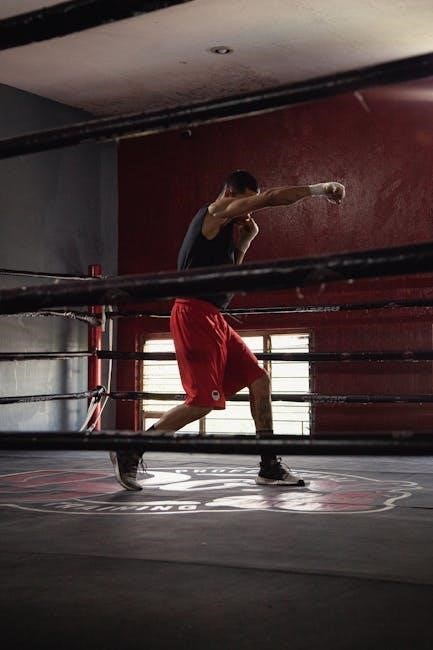
Remember, the coach dictates the training and expects compliance. A stable, balanced stance allows the boxer to follow commands and execute movements accurately. Consistent practice solidifies the stance, making it second nature.
Warm-up Exercises for Footwork Training
Prior to engaging in any intensive boxing footwork drills, a thorough warm-up is essential to prepare muscles and joints, minimizing the risk of injury. Dynamic stretching is far more beneficial than static stretching before exercise. Begin with light cardio, such as jogging in place or jumping jacks, for approximately five minutes to elevate heart rate and increase blood flow.
Specific footwork warm-ups should include exercises like ankle rotations, toe raises, heel walks, and toe walks. These movements improve ankle mobility and strengthen the muscles crucial for agile footwork. Shadow boxing with slow, deliberate footwork patterns is also an excellent preparatory exercise.
Many boxing footwork drills PDF resources highlight the importance of a proper warm-up. These guides often include detailed routines. Focus on movements that mimic the actions required in the drills you’ll be performing.
Remember, the coach oversees all aspects of training. A well-executed warm-up ensures the boxer is physically and mentally prepared to follow commands and maximize the benefits of the session.
The 12-Inch Square Drill
The 12-Inch Square Drill is a foundational exercise for developing quick, precise footwork – a staple found in many boxing footwork drills PDF resources. Imagine a square marked on the floor, each side measuring 12 inches. The boxer must maintain a balanced boxing stance within this confined space.
The drill involves rapidly stepping forward, backward, and laterally, always remaining within the square’s boundaries. Focus on small, controlled steps, maintaining balance and a consistent stance. Avoid crossing your feet. The goal is to improve agility, coordination, and the ability to change direction quickly.
Variations include adding punches while moving, or having a partner call out directions. This drill is often included in comprehensive training manuals, like Training Manual v.01 (2014), emphasizing boxing-specific exercises.
As highlighted in various guides, mastering this drill builds the fundamental skills needed for more complex footwork patterns. It’s a crucial step towards developing the agility required for effective offensive and defensive maneuvers.
The Shadow Boxing Footwork Drill
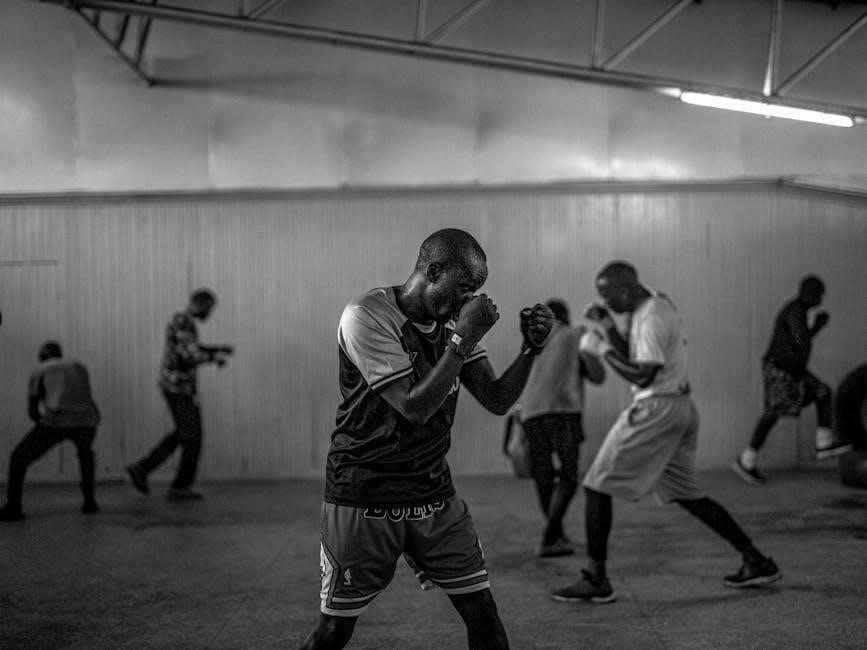
The Shadow Boxing Footwork Drill combines the visualization of a fight with focused footwork practice, a technique frequently detailed in boxing footwork drills PDF materials. Unlike static drills, this exercise emphasizes movement with intent, simulating ring generalship.
Begin by visualizing an opponent. Move around your space as if facing them, incorporating all the footwork techniques you’ve been practicing – circling, pivoting, shuffling, and backpedaling. Maintain your boxing stance throughout, focusing on balance and agility.
Crucially, integrate punches and defensive maneuvers with your footwork. Throw jabs, crosses, hooks, and uppercuts while moving, ensuring your feet are set correctly for each strike. Practice slipping, rolling, and weaving while maintaining your balance and spatial awareness.
Many training resources, including comprehensive guides, advocate for this drill as a way to groove footwork patterns and improve reaction time. It’s a dynamic exercise that bridges the gap between isolated drills and actual sparring, preparing you for the complexities of a real fight.
The Line Drill for Footwork
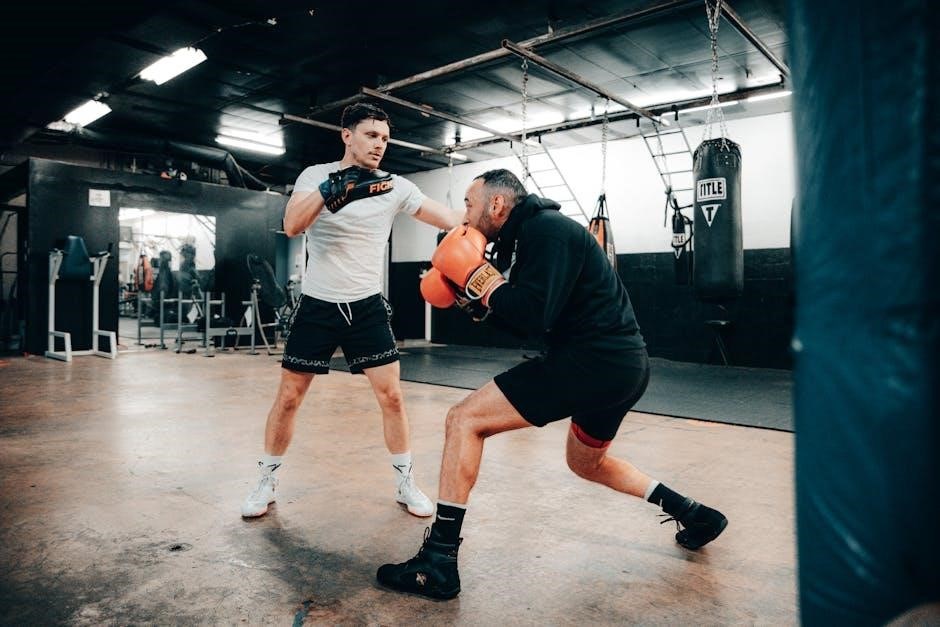
The Line Drill is a foundational exercise, often illustrated in boxing footwork drills PDF guides, designed to improve linear movement, balance, and coordination. It’s a simple yet highly effective drill for building a solid base for more complex footwork patterns.
Mark a straight line on the floor – this can be done with tape or chalk. Assume your boxing stance facing the line. The drill involves repeatedly stepping forward and backward along the line, maintaining your stance and balance throughout. Focus on small, controlled steps, keeping your weight balanced and your core engaged.
Variations include adding a shuffle step – moving laterally along the line while maintaining your stance. You can also incorporate a lead foot step and drag, emphasizing quick, efficient movement. As you progress, increase the speed and duration of the drill.
This drill, frequently highlighted in training manuals, isn’t about speed initially; it’s about precision and maintaining proper form. Mastering linear movement is crucial, as it forms the basis for circling, pivoting, and closing the distance – all essential elements of effective footwork.
The Cone Drill for Agility and Footwork
The Cone Drill, a staple in many boxing footwork drills PDF resources, dramatically enhances agility, quickness, and change-of-direction ability – vital for both offensive and defensive maneuvers. This drill utilizes cones (or markers) arranged in various patterns to challenge your footwork.
A common setup involves placing cones in a line, zig-zag pattern, or a square. The boxer then moves around the cones, maintaining their boxing stance and performing specific footwork patterns, such as shuffles, crossovers, and pivots. Focus on staying light on your feet and maintaining balance while navigating the course.
Variations include adding punches as you move around the cones, simulating combinations while maintaining footwork fluidity. You can also time yourself to track improvement and increase the intensity. Many training guides emphasize the importance of keeping your hands up and eyes forward throughout the drill.
This drill, often detailed in comprehensive footwork guides, isn’t just about speed; it’s about controlled agility and the ability to react quickly to changing directions. Mastering cone drills translates directly to improved performance in the ring.
The Ladder Drill for Footwork Speed
The Ladder Drill, frequently featured in boxing footwork drills PDF materials, is a highly effective exercise for developing rapid footwork speed, coordination, and rhythm. It utilizes an agility ladder placed flat on the floor, creating a series of squares or rungs.
Boxers perform various footwork patterns through the ladder, such as in-and-out steps, lateral shuffles, and Icky Shuffles, focusing on quick, precise movements. Maintaining a proper boxing stance – knees bent, back straight, hands up – is crucial throughout the drill. The goal is to increase the frequency and efficiency of foot movements.
Many training manuals highlight the importance of focusing on form over speed initially, gradually increasing the pace as coordination improves. Variations include adding punches or defensive slips while navigating the ladder, enhancing the drill’s complexity and realism.
Detailed in numerous footwork guides, the Ladder Drill isn’t merely about speed; it’s about developing the neuromuscular pathways necessary for quick reactions and agile movements within the ring. Consistent practice yields significant improvements in footwork speed and overall boxing performance.
Partner Footwork Drills: Mirroring
The Mirroring drill, a cornerstone of partner footwork drills often detailed in boxing footwork drills PDF resources, focuses on reactive movement and spatial awareness. It involves two boxers facing each other, with one designated as the “leader” and the other as the “mirror.”
The leader initiates various footwork patterns – forward steps, backward retreats, lateral shuffles, pivots – and the mirror attempts to precisely replicate those movements in real-time. This requires intense concentration, quick reflexes, and the ability to anticipate the leader’s actions. Maintaining a proper boxing stance is paramount.
Training guides emphasize starting slowly, focusing on accuracy before increasing speed. As proficiency grows, the leader can introduce more complex combinations and subtle changes in direction. The drill enhances reaction time, coordination, and the ability to maintain balance while moving.
Found within comprehensive boxing manuals, Mirroring isn’t just about imitation; it’s about developing the ability to read an opponent’s movements and react accordingly. It’s a valuable tool for improving defensive footwork and overall ring generalship.
Partner Footwork Drills: Reaction Training

Reaction training, frequently outlined in boxing footwork drills PDF guides, elevates partner work beyond simple mirroring. This drill emphasizes responding to unpredictable stimuli, simulating the chaotic nature of a real fight. One boxer acts as the “stimulus,” while the other focuses on reactive footwork.
The stimulus delivers non-telegraphed cues – a hand clap, a verbal command (“left,” “right,” “back”), or a subtle shift in weight – prompting the reactive boxer to move in a specific direction or perform a designated footwork pattern. The key is to react without anticipating the cue.
Boxing resources stress the importance of varying the cues and their timing to prevent the reactive boxer from falling into predictable patterns. This drill builds explosive footwork, improves peripheral vision, and sharpens the ability to change direction quickly.
As detailed in training manuals, incorporating light resistance bands can further challenge the reactive boxer’s agility. Mastering reaction drills translates directly to improved defensive capabilities and the ability to counter effectively in the ring. It’s a crucial step beyond basic footwork proficiency.
Footwork Drills with the Heavy Bag
Utilizing the heavy bag for footwork drills, as detailed in many boxing footwork drills PDF resources, bridges the gap between isolated movement practice and applying footwork within a simulated combat scenario. It’s about more than just hitting the bag; it’s about how you move while doing so.
Begin by circling the bag, maintaining balance and a consistent stance. Focus on small, controlled steps, avoiding crossing your feet. Vary your speed and direction, practicing both clockwise and counter-clockwise movement. Boxing guides emphasize maintaining hand position and head movement throughout.
Progress to incorporating punches while circling. Throw combinations while continuously moving, ensuring your footwork doesn’t compromise your power or balance. Training manuals suggest focusing on pivoting and angling off the bag after combinations, creating space and setting up follow-up attacks.
Advanced drills involve simulating ring cuts – moving diagonally across the bag, stepping in and out of range, and utilizing lateral movement to evade imaginary punches. Remember, the bag is a tool to refine footwork under pressure, preparing you for the dynamic environment of a fight.
Footwork Drills for Defensive Movement
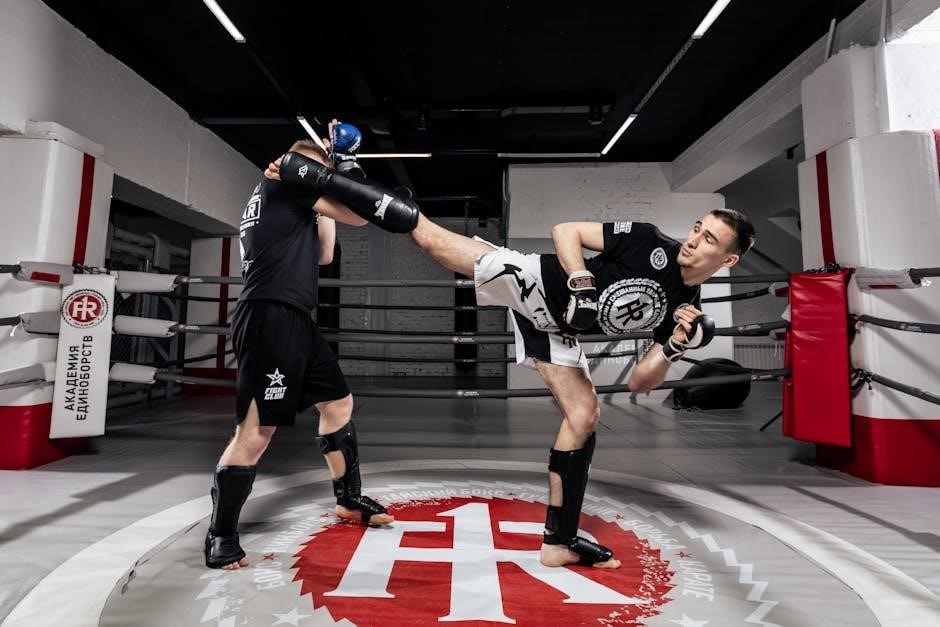
Defensive footwork, a cornerstone of boxing, is thoroughly covered in numerous boxing footwork drills PDF guides. These drills focus on evasion, distance management, and minimizing vulnerability. Mastering these techniques is crucial for avoiding damage and creating counter-attacking opportunities.
The “slip bag” drill involves circling the heavy bag while practicing slipping punches – moving your head off-line while maintaining a stable base. Focus on bending at the knees and waist, keeping your hands up, and maintaining balance. Training resources highlight the importance of smooth, fluid movements.
Another effective drill is the “pivot and evade” drill. Practice pivoting off your lead foot to create angles and escape pressure. Simultaneously, work on stepping back or to the side to increase distance. Boxing manuals emphasize keeping your weight balanced during these movements.
Shadow boxing, as detailed in many guides, is invaluable for refining defensive footwork. Visualize incoming punches and practice slipping, rolling, and moving out of range. Consistent practice builds muscle memory and improves reaction time, essential for effective defense.
Footwork Drills for Offensive Movement
Offensive footwork, detailed in many boxing footwork drills PDF resources, centers on closing distance, creating angles, and delivering power punches. These drills aim to transform defensive positioning into aggressive opportunities, dictating the pace and location of exchanges.
The “closing the distance” drill involves repeatedly stepping in and out of range, practicing controlled aggression. Focus on maintaining balance, keeping your hands up, and feinting to disrupt your opponent’s guard. Training materials stress the importance of explosive, yet controlled, movements.
“Angle creation” drills utilize lateral movement to circle opponents, opening up new attack lines. Practice stepping to the side while simultaneously pivoting to generate power and create openings. Boxing manuals emphasize maintaining a stable base and transferring weight effectively.
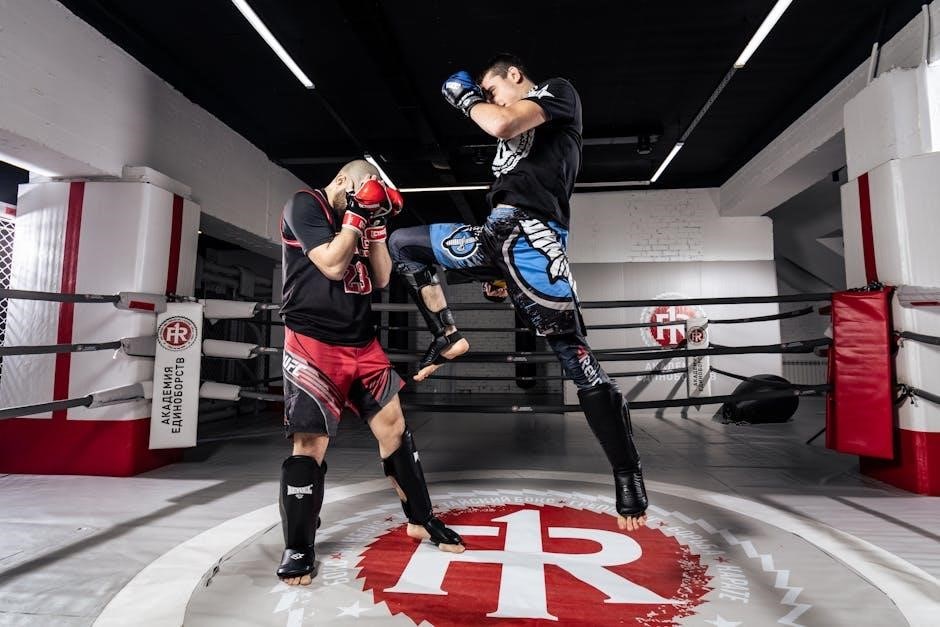
Integrating footwork with punching combinations, as outlined in various guides, is crucial. Practice stepping in with your lead foot while throwing a jab, or pivoting to create an angle for a powerful cross. Consistent repetition builds coordination and maximizes offensive impact. Remember, the coach makes all decisions related to the training.

Integrating Footwork into Punching Combinations
Successfully blending footwork with punches, a core focus of boxing footwork drills PDF materials, elevates technique beyond isolated skills. It’s about fluidity – seamlessly transitioning from movement to impactful strikes, maximizing power and minimizing vulnerability. Many guides emphasize this synergy.
Drills often begin with simple combinations: a jab followed by a cross, coordinated with a step-and-pivot motion. The lead foot steps forward as the jab extends, followed by a weight transfer and rotation for the cross. Resources like Training Manual v.01 (2014) detail these sequences.
More complex combinations involve lateral movement and angle changes. Practice circling to your left while throwing a hook, or stepping to the right and delivering an uppercut. Maintaining balance and a tight guard are paramount, as highlighted in numerous boxing resources.
When you know and have grooved punches, defensive moves and footwork on the bag, add partner drills to your routine. The goal is to create a continuous flow, where each movement sets up the next. Remember, the boxer is expected to follow the command, listen, and comply with the coach’s instructions.
Advanced Footwork Techniques: Pivoting and Angles
Mastering pivots and angles represents a significant leap in boxing footwork, often detailed within comprehensive boxing footwork drills PDF resources. Pivoting isn’t merely turning; it’s a controlled rotation, shifting your weight to create openings and evade attacks. Guides emphasize maintaining balance throughout the movement.
Angles are crucial for disrupting an opponent’s rhythm and creating advantageous striking positions. Stepping off-line – moving laterally rather than directly forward or backward – forces your opponent to adjust, leaving them vulnerable. This is a key element explored in advanced training manuals.
Drills focusing on pivoting involve practicing quick, controlled turns while maintaining a stable base. Angle work often incorporates cone drills, forcing you to navigate obstacles while maintaining proper footwork. Resources like the Boxing Footwork Guide with illustrations can visually demonstrate these techniques.
Integrating these techniques into sparring requires conscious effort. Focus on setting your feet before throwing punches, and utilize pivots to create space or close the distance. Remember, the coach makes all the decisions related to the training.
Creating a Boxing Footwork Training Plan

A structured boxing footwork training plan is essential for improvement, often outlined in detailed boxing footwork drills PDF guides. Begin with a thorough assessment of your current skill level, identifying strengths and weaknesses. This informs the focus of your drills.
Your plan should incorporate a variety of exercises, progressing from basic stances and warm-ups to more advanced techniques like pivoting and angle work. Dedicate specific sessions to each element, ensuring consistent practice. Remember, the boxer is expected to follow the command.
Utilize resources like downloadable PDF eBooks and illustrated guides to learn new drills and refine your technique. Integrate footwork into your bag work and partner drills, applying learned skills in a dynamic environment.
Periodization is key – vary the intensity and volume of your training to prevent plateaus and reduce the risk of injury. Regularly review and adjust your plan based on your progress. Consistency and focused effort are paramount to success, as emphasized in training manuals.
Resources for Boxing Footwork Drills (PDF Guides)
Numerous boxing footwork drills PDF resources are readily available online, offering comprehensive guides and structured training programs. These downloadable materials cater to all skill levels, from beginners to advanced boxers seeking refinement.
A valuable starting point is searching for “Boxing Footwork Guide with Illustrations” – often available as a free PDF file, providing visual aids to enhance understanding. Many boxing websites and coaching platforms offer premium PDF eBooks detailing specific drills and techniques.
Look for resources that cover a wide range of exercises, including the 12-inch square drill, line drills, cone drills, and ladder drills. Comprehensive manuals, like Training Manual v;01 (2014), often dedicate chapters to footwork workouts.
Remember to critically evaluate the source and author’s credentials before implementing any new drills. Supplement PDF guides with video tutorials for a more dynamic learning experience. These resources are invaluable for self-improvement and structured boxing development.